Most small businesses spend their security budget on technology: firewalls, antivirus, backups, and monitoring. All of that matters. But the uncomfortable lesson from years of breach data is that most attacks do not succeed by defeating your technology. They succeed by tricking one of your people. This is why security awareness training has moved from optional to a basic part of protecting a business. It is the work of helping your team recognize and resist the scams and manipulation that walk straight past your technical defenses. This article explains what that training is, why it matters more than most owners assume, what good training actually looks like, and the honest limits of what it can do.
The Importance of Security Awareness Training, Explained

By nazy rafaeil
14 June 2026

What security awareness training actually is
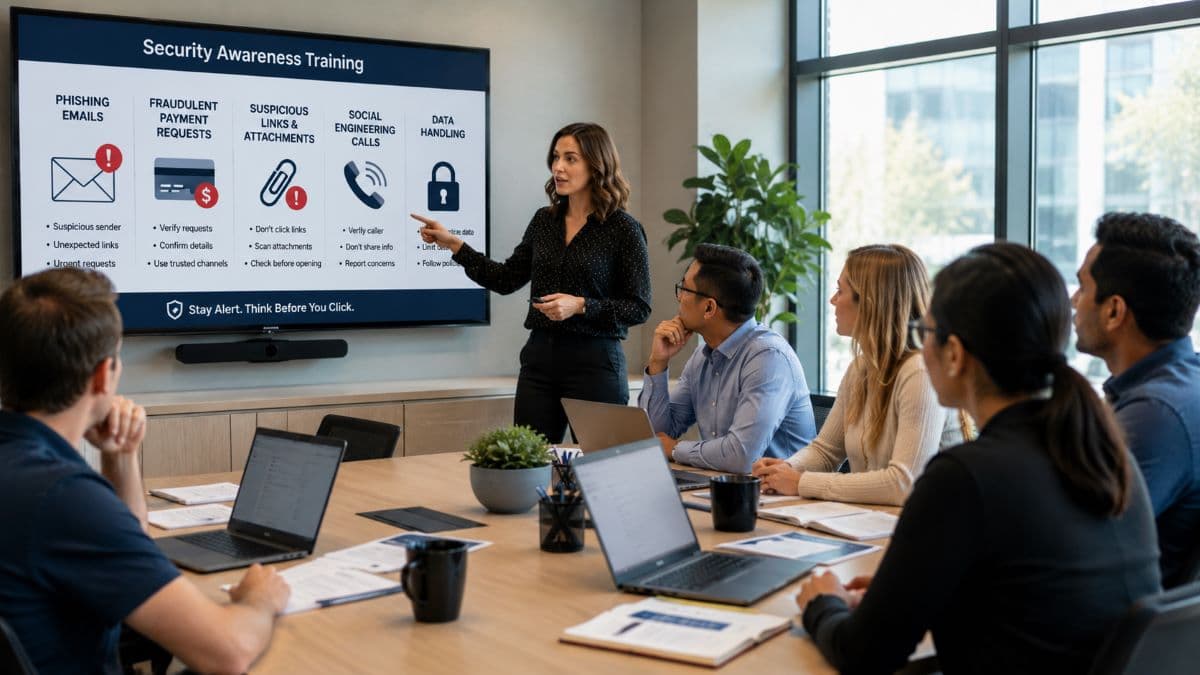
Security awareness training is an ongoing program that teaches the people in your business how to recognize and respond to the threats aimed at them. At its core it covers the attacks that target human judgment rather than software flaws: phishing emails, fraudulent payment requests, suspicious links and attachments, social engineering phone calls, and careless handling of sensitive data. The key word is ongoing. A single onboarding video that someone watches once and forgets is not a program, it is a checkbox. Real training is delivered in small, regular doses, kept current with the scams actually circulating, and reinforced with practice so the lessons stick. Done well, it turns your staff from the easiest way into your business into a layer of defense that technology alone cannot provide.
Why it matters more than most owners assume
The case for training rests on a pattern that shows up in the data every year. According to Verizon's Data Breach Investigations Report, around 60 percent of breaches involve a human element, meaning a person was tricked, made a mistake, or misused access. Phishing remains one of the most common ways in, beginning roughly one in six breaches. Attackers focus on people for a practical reason: it is usually easier to fool an employee into handing over a password than to break through a properly configured system, which is exactly why employee awareness belongs alongside your technical cybersecurity solutions rather than as an afterthought.
The threat has also become harder to spot. Criminals now use generative AI to write convincing, well-targeted messages without the clumsy spelling that used to give them away. Business email compromise, where a scammer impersonates an executive or a vendor to redirect a payment, has become one of the costliest attacks facing small businesses, and it works precisely because it relies on trust rather than malware. Understanding how these scams are built is the first step to stopping them, which is why practical guidance on business email compromise pairs naturally with hands-on training.
What good security awareness training looks like
If training is going to change behavior, it has to be more than an annual slideshow. The programs that actually work share a few traits. They run continuously throughout the year rather than once, because awareness fades and the threats keep shifting. They use simulated phishing, controlled fake phishing emails sent to staff, so people get safe practice at spotting the real thing and you can see where the gaps are. They are tailored to roles, since the risks facing your finance team are not the same as those facing your front desk. And they keep each lesson short and relevant, because busy people do not absorb hour-long lectures. Just as important, good training measures the right thing. The aim is not only a lower click rate, it is a workforce that notices something suspicious and reports it quickly.

The honest part: what training cannot do
Training deserves an honest pitch, not an inflated one. It will not get your click rate to zero. The same breach research that shows people are the main target also shows that even well-trained employees still click sometimes, because a convincing message sent at the wrong moment can fool almost anyone. That is not an argument against training, it is the reason training has to be one layer among several rather than the whole defense. Its real value is twofold. It lowers your overall risk by making your team harder to fool, and it shortens the time between an attack landing and someone raising the alarm, which is often what decides whether an incident stays contained or becomes a breach.
This is also why training works best next to technical controls that catch what people miss. Strong phishing-resistant multifactor authentication means that even if a password is stolen, an attacker still cannot easily walk in with it.
Layered email security matters too, because filtering that blocks malicious messages before they reach an inbox reduces how often your people are tested in the first place. Tightening your Microsoft 365 security settings is a practical example of that kind of technical backstop. The goal is a system where training, technology, and good habits cover each other's gaps.
Training, compliance, and proof
For businesses in regulated industries, security awareness training is not only sensible, it is often required. The HIPAA Security Rule directs covered organizations to put a security awareness and training program in place for their entire workforce, and regulators expect to see evidence that it happens. The Payment Card Industry Data Security Standard sets a similar expectation, requiring a formal security awareness program for anyone who handles cardholder data. In both cases the documentation matters as much as the activity itself. If your security posture is ever examined after an incident or during an audit, being able to show a current, consistent training program is part of demonstrating that you took reasonable steps to protect the data you hold.

Making security awareness training work in a small business
Smaller businesses sometimes assume this kind of program is only for large companies with dedicated security teams. The opposite is closer to the truth, because attackers know smaller firms often have thinner defenses, and a single successful scam can do proportionally more damage. The encouraging part is that an effective program does not have to be expensive or complicated. A few principles carry most of the weight: keep sessions short and regular so they fit into real workdays, have leadership take part so the effort is clearly taken seriously, and make reporting a suspicious message easy and blame-free so people speak up instead of staying quiet out of embarrassment. For many businesses in Woodland Hills and the surrounding area, the simplest path is to have a provider run the program as part of their wider security work, so it stays consistent without becoming another job for an already stretched team. None of this makes training a magic shield, and any honest provider will say so, but it remains one of the highest-return steps a small business can take to close the gap that technology alone cannot.
Frequently Asked Questions
It is an ongoing program that teaches employees how to recognize and respond to cyber threats aimed at people, such as phishing emails, fraudulent payment requests, and social engineering. Rather than a one-time video, effective training runs regularly and is reinforced with practice, so staff become a working part of your defenses instead of the easiest way in.
Regularly, not once a year. Awareness fades and the scams keep changing, so most effective programs deliver short lessons throughout the year and run periodic phishing simulations to keep skills sharp. Frequent, brief touchpoints tend to change behavior far more than a single long annual session.
Yes, though not by eliminating every mistake. Breach research shows that even trained employees occasionally click a convincing message, so training is one layer rather than a complete defense. Its value is in lowering overall risk and, just as important, getting staff to spot and report suspicious activity quickly, which often decides whether an incident is contained.
In many regulated industries, yes. The HIPAA Security Rule requires a security awareness and training program for the workforce, and the PCI DSS requires a formal program for staff who handle cardholder data. In both cases, keeping documented evidence that training happens is part of demonstrating compliance.
If you want help building a practical security awareness training program that fits how your team actually works, GlobeVM can put one in place and keep it running as part of your security strategy for businesses across Los Angeles and the surrounding area.
Comments
0 Comments