Code of Civil Procedure section 337.15 bars any action for damages arising from a latent deficiency in the design, planning, supervision, or construction of an improvement to real property more than ten years after the substantial completion of the improvement. A latent deficiency is one that is not apparent by reasonable inspection, which describes most of what goes wrong inside walls, under slabs, and behind roofing. Section 337.1 sets a shorter four-year period for patent deficiencies, the ones a reasonable inspection would reveal.
Why Construction Project Records Retention Is a Ten-Year Problem in California

By George
30 August 2026

Two features of the ten-year rule matter for recordkeeping. First, the clock starts at substantial completion, which subdivision (g) defines as the earliest of final inspection by the public agency, recordation of a valid notice of completion, use or occupation of the improvement, or one year after work on the improvement stopped. Second, the statute expressly covers actions for indemnity, so a general contractor sued in year nine can cross-complain against the subcontractor whose work is at issue, which means a trade contractor's exposure runs just as long as the general's. The period does not apply to claims based on willful misconduct or fraudulent concealment, and courts have held it does not limit personal injury claims, so ten years is the floor of the exposure rather than a guarantee.
Residential work adds its own layer. The Right to Repair Act in Civil Code sections 895 and following sets functionality standards for new homes with specific, sometimes shorter, periods for particular components, and it carries its own pre-litigation procedure. Sophisticated parties can also shorten or modify limitation periods by contract, as a 2013 Court of Appeal decision confirmed. Every one of these provisions has been litigated and amended over the years, so the numbers here should be read as the state of the law at the time of writing and confirmed with construction counsel before a retention schedule is finalized.
What the Clock Means for a Contractor's Records
In a defect case the contractor's own records are the defense. The daily log shows the weather and the crew on the day the flashing went in, and the photographs show the substrate before it was covered. The submittal shows the product the architect approved, the RFI shows the question that was asked and the answer that came back, the inspection report shows the city signed off, and the change order shows the owner chose the cheaper detail. A contractor who cannot produce those documents is arguing from memory against an owner's consultant with a thermal camera.
"Keeping" those records therefore means three things at once: the files still exist, they can be opened in whatever software exists a decade from now, and someone can find the right project's records among hundreds without a three-week search. Most retention failures in construction are failures of the second or third kind. The files were never deleted; they were simply trapped in a dead platform, an old employee's phone, or an unlabeled drive.
The Other Clocks Running at the Same Time
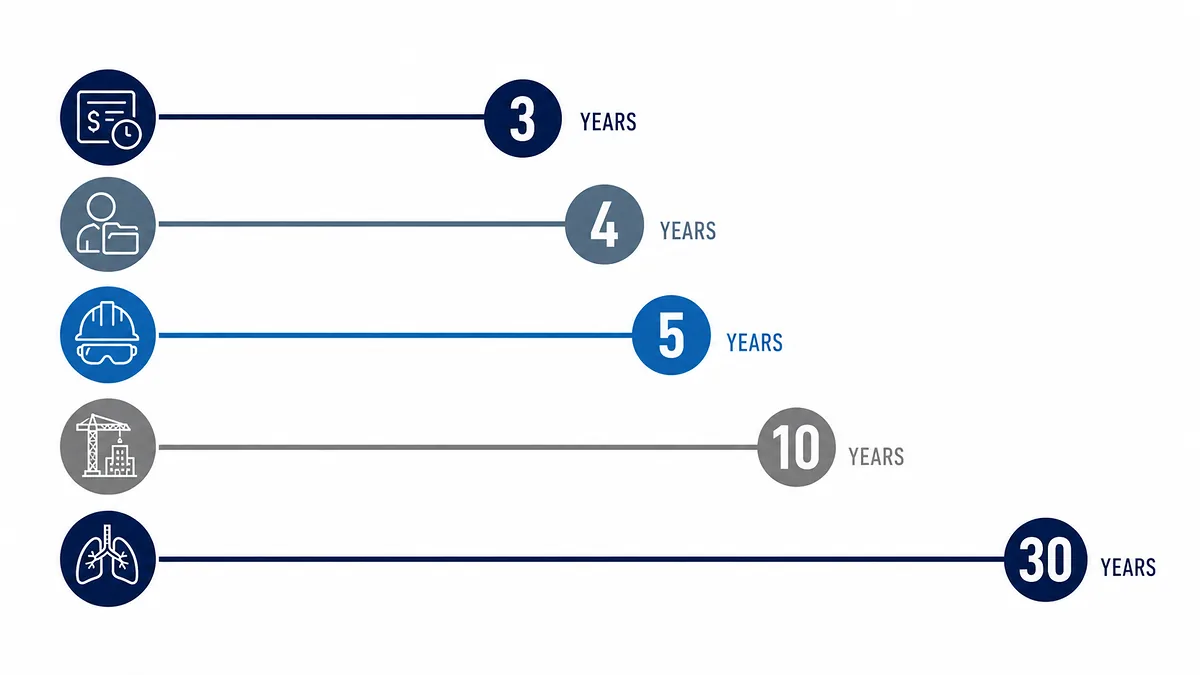
The defect statute gets the attention, but a California contractor's records answer to several other authorities with their own minimum periods, all of which are floors rather than ceilings. Cal/OSHA Forms 300, 300A, and 301 must be kept for five years following the end of the calendar year they cover under 8 CCR 14300.33. Personnel files and applications must be kept for four years from creation or from the employment action under Government Code 12946 as amended by SB 807, a period that was lengthened in 2022.
Payroll and time records must be kept for at least three years under Labor Code 1174(d) and 226, and four years has become common practice because wage claims reach back four years and the unemployment insurance rules use the same period. Certified payroll on public works must be kept accurate, certified, and producible on request under Labor Code 1776.
Three more clocks run in the background. Workers' compensation claim files are kept for five years from the date of injury or the last benefit payment, whichever is later, under a rule written for claims administrators, so a contractor should confirm its own obligation with its carrier. Employee exposure records are kept for thirty years and medical records for the duration of employment plus thirty years under the Cal/OSHA and federal OSHA access standards. Tax records follow IRS guidance, which is generally three years, longer in several situations, and, for records supporting the basis of property, until the limitation period for the year of disposal ends.
Two cautions belong next to those numbers. The employment periods apply to the whole company rather than to a project, so they should be handled by payroll and HR systems rather than buried in project folders. And every period above is the minimum the law requires, not a recommendation; a contractor's insurer, surety, or counsel may reasonably ask for longer, and a written data retention policy should record which number was chosen and why.
What to Keep for Every Project
A retention schedule that says "keep project records ten years" is useless if nobody agreed what a project record is. The closeout record set should be defined once, in writing, and applied to every job regardless of size. For most general and specialty contractors it includes the following:
- The executed contract, every change order, and the correspondence that led to each one
- Bid documents, estimates, and the scope clarifications exchanged before award
- Plans and specifications, including every revision and the record of which set governed at each stage
- Submittals, RFIs, and the responses to each, with dates
- Daily logs, including weather, manpower, equipment, and deliveries
- Dated photographs and video, especially of work that was covered or concealed
- Inspection reports, permits, certificates of occupancy, and the recorded notice of completion
- Schedules as issued and as updated, and meeting minutes
- Subcontracts, purchase orders, certificates of insurance, and lien releases
- Pay applications, invoices, and the project cost ledger
- Closeout documents: as-builts, warranties, operation and maintenance manuals, and commissioning reports
- Safety documentation specific to the site, including orientation records and incident reports
The list is long because the defense in year nine is usually built from the dull documents rather than the dramatic ones. A daily log entry noting that the owner's representative directed a substitution is worth more than any expert's opinion about what should have been installed.
Email and Text Messages Are Project Records Too
The hardest category is the one nobody files. Project direction is given by email and, increasingly, by text message between superintendents, subcontractors, and owners' representatives, and the message that says "owner approved the cheaper flashing, proceed" lives on one person's phone rather than in a company-controlled cloud-based business phone system. When that person leaves, the record leaves with them, and a contractor that cannot produce the text is left explaining why the approval exists only in someone's recollection.
The practical fixes are organizational rather than technical. Project email should be captured to the project, either by routing it through the project management platform or by archiving mailboxes with a retention policy that survives the employee's departure. Business texting should move to company-controlled numbers that can be archived, or at minimum be photographed into the daily log when it carries direction. A contractor that runs its field communications through company numbers with texting enabled gets both the capture and the record without asking foremen to change how they talk to trades.
Where Construction Records Actually Live, and Why That Is the Risk
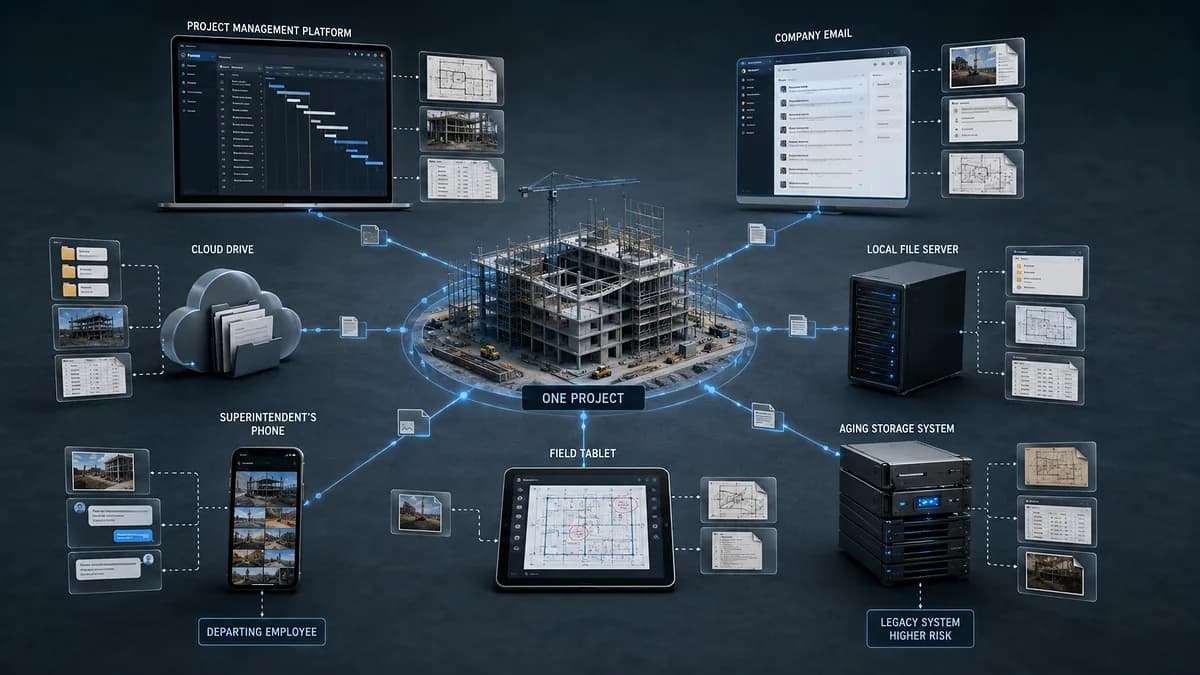
Twenty years ago a project's records lived in a job box and then in banker's boxes in a warehouse, and the retention problem was space and mildew. Today the same project's records are scattered across a subscription platform, several phones, a file server, two cloud drives, and the email of everyone who touched the job, and the retention problem is that each location has its own lifespan, owner, and exit rules. It is a data protection problem before it is a storage problem, because records that can leave with a person or a vendor are not really kept at all.
Project Management Platforms Keep Data on Their Terms
Platforms such as Procore, Autodesk Construction Cloud, and Buildertrend are where most active-project records are created, and they are excellent at it. They are not archives. Access to a closed project depends on the contractor still holding a subscription, the project not having been purged under the vendor's data retention terms, and the vendor still existing in a recognizable form a decade later. A contractor that switched platforms in 2022 may already be unable to open a 2019 project without reactivating an old account, if that is even possible.
The answer is an export at closeout, before the project is archived in the platform and before anyone is thinking about a different vendor. Every platform can export documents, logs, photos, and RFIs, usually as PDF and spreadsheet files with the native files alongside, and the export should be treated as the official record of the project from that day forward. The platform copy is a convenience; the export is what the contractor will produce in year nine. Our guide to IT support for construction companies covers choosing and connecting the platform stack itself; this section is about what happens to its data afterward.
Phones, Personal Email, and Field Devices
Field photographs are the most valuable and least protected record a contractor has. They are taken on superintendents' phones, sometimes uploaded to the platform and sometimes not, and they leave the company when the superintendent does, or when the phone is dropped in a trench. The same is true of messages, voice memos, and the personal email accounts some field staff still use for project business.
A device management policy fixes more of this than any single tool. Company-managed phones, or personal phones enrolled with a managed work profile, can require that photos from the camera app used for work sync automatically to company storage, can wipe company data when an employee leaves, and can keep personal photos out of the company's reach at the same time. Our guide to BYOD security risks covers the boundaries that make that arrangement acceptable to a crew that did not sign up for surveillance.
File Servers, Cloud Drives, and the Backup That Is Not an Archive
Most contractors keep a file server or a cloud drive with a folder per project, and most of them believe the backup of that server satisfies retention. It does not, for a reason that only becomes visible during a retrieval. A backup is a copy of what exists now, designed to restore the server after a failure, and it keeps a limited number of generations before overwriting them. A project folder that was deleted, moved, or accidentally overwritten in 2021 is not in a backup rotation that keeps thirty days, and it is not in the server either.
An archive is different in purpose and in configuration: it is a deliberate copy of a closed project, stored in a location that is not overwritten, with its own retention date. The two disciplines overlap enough that a contractor's retention schedule should describe both, but they are not substitutes, and the contractor that only has backups has typically lost more closed-project data than it realizes.
Why Ransomware Changed the Archive Conversation
Construction companies have been heavily targeted by ransomware because they pay quickly to keep projects moving, and an attack that encrypts the file server also encrypts ten years of closed projects if the archive is just another folder on the same server. Archives should be stored where an attacker with the company's own credentials cannot change or delete them, which is what the immutable backups discussion is really about once applied to long-term records. Cloud storage with object locking, or an archive tier with retention enforced by the provider, is the current practical answer for a contractor without a data center.
How to Make a Closed Project Retrievable in Year Nine
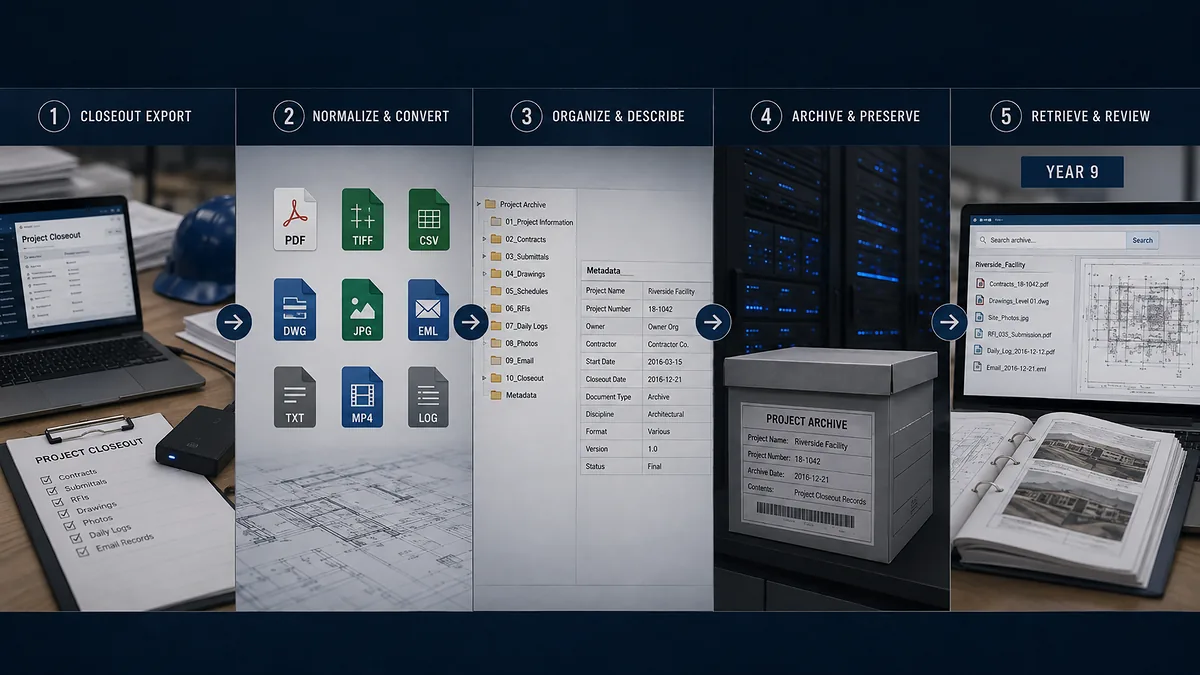
The goal is a closed project that a new office manager, in a different office, on different software, can locate and open in an afternoon. The sequence below produces that result and adds roughly a day of work to each project closeout:
- Define the closeout record set in writing and assign one person to assemble it for each project.
- Export the project from every platform into open formats: PDF for documents, CSV or spreadsheet files for logs and registers, native files alongside PDF for drawings, and original image files for photographs with their date metadata intact.
- Gather the records that never made it into the platform: email folders, archived texts, phone photos, and paper scanned at closeout.
- Store the package in a project archive with a fixed folder structure, named by project number, address, and year of substantial completion.
- Record the substantial completion date, the basis for it, and the calculated retention end date in an index that lives outside the archive itself.
- Write the archive to storage that cannot be altered or deleted for the retention period, and keep a second copy in a different location.
- Restrict who can open closed projects to a short list, and log access.
- Once a year, pick a project from five or more years ago and confirm that a staff member can find it, open every file type, and produce the RFI log within an hour.
Step eight is the one contractors skip. It is also the one that finds the problems while they are still cheap: a drawing format nobody can open anymore, an export that silently dropped the photo metadata, or an index that was never updated after a server migration.
Calculating the Destruction Date
The retention end date for project records is substantial completion plus ten years, plus whatever buffer counsel recommends, and nothing in the archive should be destroyed before it. Three situations extend the date. A claim, a demand letter, or any notice that a dispute is possible triggers a duty to preserve that overrides the schedule, and a contractor should suspend destruction for the affected project the day the notice arrives, the same way a legal hold suspends deletion in any other business. Residential projects under the Right to Repair Act may have component-specific periods and pre-litigation procedures that counsel should map. And records that also serve payroll, safety, or tax purposes follow the longer of the applicable periods, which is why employment records should not be stored inside project folders in the first place.
Archive Storage Is Cheap, Retrieval Is Not
Cost objections to a ten-year archive rarely survive arithmetic. Long-term cloud storage is priced per gigabyte per month at rates that make a decade of a mid-sized contractor's closed projects cost less than a single day of a forensic consultant. The expensive part of retention is retrieval under pressure: paying an IT provider to rebuild a dead server, paying a former employee to remember, or paying counsel to explain why the records do not exist. The disciplined closeout above spends the money at the cheap end.
Where Contractors Most Often Fall Short on Records Retention
The gaps found in a records review are consistent across general contractors, specialty trades, and design-build firms. The usual list looks like this:
- No written definition of the closeout record set, so each project manager keeps what they personally find useful
- Closed projects left inside a platform the company may not subscribe to in year nine
- Photographs and texts that exist only on field employees' personal phones
- Backups mistaken for archives, with a rotation that overwrites deleted folders within weeks
- Archives stored on the same server as live data, exposed to the same ransomware event
- No index of substantial completion dates, so nobody knows when a project's clock actually runs out
- Destruction performed by whoever needs disk space rather than by schedule, with no record of what was destroyed and when
The last item deserves emphasis. Disposal is a decision with its own record, and a contractor that can show a dated destruction log for projects past their retention date is in a far better position than one that simply cannot find something. Our guide to secure disposal of old devices and documents covers the certificate-of-destruction discipline that applies equally to a decade-old project archive.
What This Looks Like for a Southern California Contractor
Contractors across Los Angeles, the Santa Clarita Valley, and Ventura County work in a market where a decade of exposure overlaps with an unusually active construction defect bar, seismic and water-intrusion issues that surface slowly, and a steady churn of superintendents between companies. The firms that handle it well treat records retention as part of project closeout, not as an IT project, and they give the archive the same attention as the final pay application.
GlobeVM works with construction companies across the region, including through its Santa Clarita IT support practice north of the city, on the technology side of that discipline: the platform exports, the device management that captures field photos and messages, the archive storage that ransomware cannot reach, and the annual retrieval test that proves it all still works. The office and the job sites are rarely in the same place, which is exactly why the records need a single home that does not depend on either.
The first conversation is usually short. A contractor lists its last five closed projects, and together we try to open each one's RFI log and photographs from wherever they currently live, which tells the company more about its real retention posture in an hour than any policy document would.
Build the Archive at Closeout, Not at the Deposition
Construction project records retention in California is a ten-year commitment with several shorter clocks inside it, and the commitment is to retrievability rather than mere possession. A contractor that defines the closeout record set, exports every project into open formats, captures the emails and texts and photos that never reached the platform, stores the package where it cannot be altered or encrypted, indexes the substantial completion date, and tests retrieval once a year has built the defense before anyone needs it.
The alternative is discovering in year nine that the records exist in theory and nowhere in practice. If your company has closed projects sitting in a former platform, on former employees' phones, or on the same server as everything else, a short review of where your records actually live is the place to start, and GlobeVM can walk through it with you alongside our overview of IT and cybersecurity for construction firms.
Frequently Asked Questions
At least ten years from substantial completion, because Code of Civil Procedure section 337.15 allows latent defect claims, including indemnity claims against subcontractors, for that long. Payroll, personnel, safety, and tax records carry their own shorter minimums, and counsel or an insurer may recommend a longer project period, so the chosen number should be written into a retention schedule with its reasoning.
Section 337.15 bars actions for latent deficiencies more than ten years after substantial completion, and section 337.1 bars actions for patent deficiencies more than four years after substantial completion. The ten-year period does not apply to willful misconduct or fraudulent concealment and does not limit personal injury claims, and residential projects are also subject to the Right to Repair Act's component-specific periods.
Yes, whenever they document direction, approvals, conditions, or work on a project, regardless of whose phone they are on. A contractor should capture them through company-controlled phone numbers, managed devices that sync work photos to company storage, and a closeout step that gathers messages and images that never reached the project platform.
No, because a backup restores the current state of a server and keeps only a limited number of generations, so a project folder deleted or overwritten years ago is not in it. Retention requires a separate archive of each closed project, stored where it cannot be altered or deleted for the retention period, with its own index and retrieval test.
Open formats that will still open a decade later: PDF for documents, CSV or spreadsheet files for logs and registers, original image files with date metadata for photographs, and native drawing files kept alongside PDF versions. The export should be taken from the project platform at closeout and treated as the official record from then on.
After the retention end date, normally substantial completion plus ten years plus any buffer counsel recommends, and only if no claim, demand, or notice of a possible dispute has arrived for that project. Destruction should follow the written schedule, be performed by a named person, and be recorded in a dated log so the company can show what was destroyed and when.
Comments
0 Comments