
A construction company's most valuable technology decisions rarely happen at a desk. They happen on a job site with spotty signal, in a truck between locations, and in the gap between a general contractor's office and a crew working somewhere else entirely, and most small construction firms are running the technology of an office-bound business stretched awkwardly over an operation that barely has an office at all.
This guide covers what IT support for construction companies actually needs to address: the connectivity reality of a distributed workforce, the project software holding schedules and budgets together, a payment-fraud risk that rivals real estate in its price tag, and what to look for in a provider who has supported this industry before.
Why Construction IT Looks Nothing Like Office IT
The starting assumption behind most small-business technology, that people work from a fixed location on a company network, breaks down almost completely in construction. Project managers split time between a home office, a job trailer, and a truck. Superintendents run active sites with intermittent cell signal and no reliable Wi-Fi. Crews need access to plans, schedules, and safety documentation wherever the work actually is, which changes by the week or the day.
This is not a business that happens to have some remote workers; it is a business whose real operation lives outside the office by default, with the office serving as a coordination point rather than the center of activity.
Technology built around the assumption of a stable office network fails this reality constantly, which is why IT support for construction companies has to start from mobile and field access as the baseline, not as an exception layered on top of a traditional setup.
The Software Stack Holding a Project Together
Construction runs on a specific set of tools that a generalist provider often has not configured before. Project management platforms track schedules, budgets, change orders, and documentation across every active job, and downtime here does not just inconvenience one person, it stalls decisions across an entire site.
Estimating and takeoff software feeds directly into the bids that determine whether an entire project will actually be profitable long before a single hour of labor is ever billed, which makes its accuracy and availability a financial issue as much as a technical one.
Document and drawing management, increasingly including building information modeling on larger projects, holds files that must stay current and correctly versioned, since a crew working from an outdated drawing is an expensive and sometimes dangerous mistake. And accounting and payroll systems have to handle the specific complexity of construction billing, progress payments, retainage, and multi-project cost tracking, that generic small-business accounting software was never built for.
A provider unfamiliar with this stack spends the first months of an engagement learning it on your account rather than already knowing it.
Connectivity for Sites That Do Not Have Any
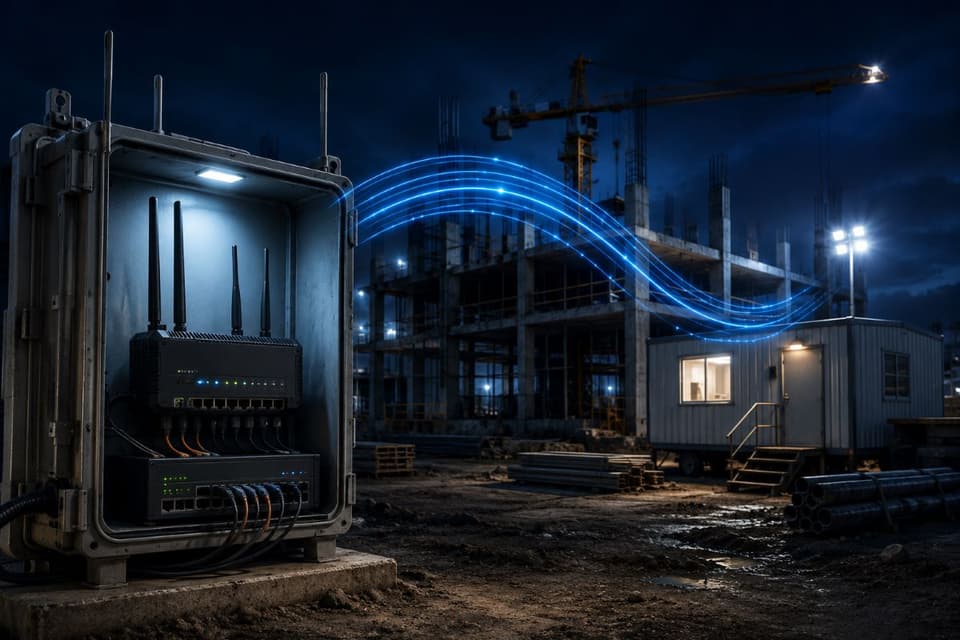
The single most distinctive technical challenge in construction IT is providing usable connectivity somewhere that was never wired for it. Cellular hotspots and site-specific connectivity solutions have become standard equipment on active jobs, not a convenience but a requirement for anyone who needs to pull a drawing, submit a report, or process a change order without driving back to the office.
| Option | Setup time | Throughput | Best for | Watch-outs |
|---|---|---|---|---|
| Phone hotspot | Minutes | Low; shared with the phone | A superintendent checking plans for a week | Data caps, drops when the phone leaves |
| Cellular router with external antenna | Hours | Good where there is signal | Most job sites for the life of the project | Carrier coverage varies by site; test before committing |
| Low-earth-orbit satellite | Same day | Good almost anywhere | Rural sites and areas with no cellular service | Needs a clear sky view; power and mounting |
| Fixed wireless or fiber to a trailer | Days to weeks | Best | Long projects and large sites | Install lead time; contract terms |
The practical planning question for any new project is connectivity from day one: what will actually work at this specific location, how will it handle a crew larger than one or two people pulling data at once, and what is the fallback when the primary option fails, because a site with no connectivity plan defaults to paper and phone calls, which is precisely the slow, error-prone workflow modern project software exists to replace.
The Fraud Risk Nobody Talks About Enough
Construction shares an underappreciated risk profile with real estate: large sums of money move between parties who communicate primarily by email, on a schedule with enough legitimate last-minute changes that a fraudulent one does not stand out. Progress payments to subcontractors, supplier invoices, and change-order billing all follow a pattern attackers have learned to exploit, compromising or spoofing an email account and inserting altered payment instructions into a conversation that already expects them.
A general contractor managing payments to a dozen subcontractors across several active projects is effectively managing a dozen separate relationships an attacker could impersonate at any given moment, and the financial exposure per incident is often significant given the typical size of a construction progress payment, sometimes representing weeks of a subcontractor crew's payroll in a single transfer.
The defense mirrors what works everywhere this scheme appears: any change to payment instructions, for any vendor or subcontractor, gets verified by a phone call to a previously known number, never a number provided in the email containing the change, made a firm policy rather than a suggestion.

Change Orders Are a Documentation Discipline, Not Just a Form
Every construction project accumulates change orders, and how cleanly a company documents them often determines whether a disputed bill gets paid without argument or turns into a drawn-out collections problem months later. A change order tracked consistently inside project software, with the approval, the cost, and the reason all attached to the same record, is evidence a company can point to with confidence.
A change order remembered as a verbal agreement or scribbled on a job-site notepad is a dispute waiting to happen, and it is squarely a technology and process problem long before it becomes a legal one.
Insurance Certificates and Vendor Documentation Add Up Fast
A general contractor coordinating multiple subcontractors and suppliers accumulates a steady stream of insurance certificates, licenses, and compliance documents that need to stay current and quickly retrievable, since working with an expired certificate on file is a liability exposure that surfaces at the worst possible time, usually after an incident rather than before one.
Tracking this documentation in a shared drive of scattered PDFs, rather than a system built to flag expirations before they lapse, is a quiet risk that has nothing to do with hacking and everything to do with basic technology hygiene.
A provider offering real IT support for construction companies should be able to help set up automated tracking for exactly this kind of recurring compliance document, turning a manual, easy-to-miss task into something the system watches instead of a person remembering to check.
Equipment and Asset Tracking Is a Technology Problem Too
Construction companies own or lease significant equipment, and the technology managing that equipment, tracking systems, telematics, maintenance scheduling, increasingly runs through the same connected systems as everything else the business depends on. A tracking system that goes down does not just lose visibility into where a piece of equipment is; it can delay a project waiting on equipment nobody can locate, and the maintenance data these systems hold is what prevents costly breakdowns during active work.
This is a smaller piece of the overall technology picture than project software or connectivity, but it is easy to overlook until an outage makes the gap obvious.
Data That Deserves More Protection Than It Usually Gets
A construction company's systems hold more sensitive material than the industry's rough-and-ready reputation suggests: detailed financial information on every active project, employee and subcontractor personal information for payroll and insurance purposes, client and property details, and increasingly, safety and compliance records that carry real liability if mishandled.
This data usually sits across several disconnected systems, project software, accounting, a shared drive somewhere, without the kind of consistent access control or backup discipline a business handling this much sensitive information should have. Bringing that scattered data under a real backup and security posture is unglamorous work, but it is exactly the gap between a construction company that survives a ransomware incident with a day of disruption and one that loses weeks of project history it can never fully reconstruct.
What to Look for in a Construction IT Provider
The selection criteria for this vertical are specific enough to be worth listing directly: GlobeVM's IT support for construction companies is built around exactly these requirements, and the checklist below is the one we use.
- Field-first thinking: does the provider default to office-network assumptions, or plan around job-site connectivity and mobile access.
- Familiarity with the actual software: has the provider configured project management, estimating, or document management tools construction firms actually use.
- A real payment-fraud protocol: a specific, documented verification procedure for progress payments and subcontractor changes, not a general security promise.
- Fast response for active sites: downtime on a live job costs money by the hour, which raises the bar on how quickly a provider needs to respond compared to a typical office.
- A plan for multiple, changing locations: comfort setting up and tearing down connectivity and equipment access as projects start and finish.
A provider who answers these with specific examples from construction clients is telling you something different than one offering the standard managed-services pitch, and that difference tends to show up fastest during the first real site-connectivity problem, when generic experience runs out of answers.
Insurance and Bonding Depend on This Too
A construction company's general liability and bonding relationships increasingly touch its technology posture, even when that connection is not obvious at first. Insurers underwriting a contractor's coverage look at claims history, and a data breach or a payment-fraud loss traced back to weak email security becomes part of that history the next time coverage is up for renewal.
Bonding companies evaluating a contractor's financial reliability care about the integrity of the financial records behind that evaluation, records that live inside the same project and accounting software this article has already described. A construction company that treats its technology as separate from its insurance and bonding relationships is missing a connection those relationships are increasingly making on their own, whether the contractor notices or not.
Build the Technology Around Where the Work Actually Happens
The construction companies that struggle with technology are almost always the ones running office-style IT stretched over an operation that lives on job sites, in trucks, and across a dozen shifting locations at once. IT support for construction companies done right starts from that reality instead of fighting it: connectivity planned for wherever the work is, project software a provider already understands, a payment-fraud protocol matched to how subcontractor billing actually works, and response times that respect what an hour of site downtime actually costs. Get that foundation right, and the technology stops being the thing that slows a project down.
For construction firms across the metro, a partner providing managed IT services in Los Angeles can plan connectivity for your next site and review your payment-verification process before it gets tested by an attacker.
Firms in the Conejo Valley can get the same locally through IT support in Thousand Oaks, from equipment tracking to a security baseline that travels with every crew.
A short conversation about managed IT services built for how construction actually operates is the right place to start. A separate look at cybersecurity solutions sized for a distributed field crew rather than a fixed office rounds out the conversation.
Companies in the Valley can get the same locally through IT services in the San Fernando Valley, from project software setup to protecting the data scattered across your active jobs.
If your crews are still working around bad job-site connectivity or nobody has reviewed how your subcontractor payments get verified, GlobeVM can bring IT support for construction companies up to the standard your projects actually need.