
A veterinary practice runs on more technology than most owners give it credit for: a practice management system tracking every patient, appointment, and invoice; diagnostic imaging equipment generating large files that need somewhere reliable to live; a payment system processing client transactions daily; and, increasingly, systems that need to keep working during an after-hours emergency when the whole point of the visit is that it could not wait.
This guide covers IT support for veterinary practices specifically: the software holding daily operations together, why the absence of HIPAA does not mean the absence of real data risk, the payment and imaging systems that deserve more attention than they usually get, and what a practice should look for in a provider who understands this business.
The Software a Practice Cannot Run Without
Practice management software is the operational center of a veterinary business, holding patient records, appointment scheduling, treatment history, inventory, and billing in one system that every part of the practice depends on throughout the day.
When this system is slow or unavailable, the practice genuinely does not have a workaround; the front desk cannot check anyone in, technicians cannot pull treatment history, and the whole day's appointment schedule backs up behind a technology problem that has absolutely nothing to do with medicine.
This makes uptime and reliable backup for the practice management system a genuinely higher priority than in many small businesses, where a software outage is an inconvenience rather than an immediate operational stop. A provider supporting a veterinary practice needs to treat this particular system with the same urgency the practice itself does, because a slow response to a practice management outage is functionally a slow response to the entire clinic, not just to one piece of software.
Sensitive Data That Is Not About the Patient
A common and understandable assumption trips up a lot of thinking about veterinary data security: animal patients are not covered by HIPAA, so the reflex is to assume the stakes are lower here than in human healthcare. That assumption misses where the actual sensitive data lives.
Every client record includes the pet owner's name, address, phone number, email, and payment information, standard personal data that carries the same value to an attacker regardless of what species the associated patient happens to be. Larger practices and specialty referral centers also increasingly hold detailed financial information tied to higher-cost treatments, payment plans, and financing arrangements, which raises the stakes further.
The absence of a specific veterinary privacy law does not mean the absence of real obligations or real consequences, general consumer protection and data breach notification laws still apply in full, and a practice's professional reputation in a community that talks to itself constantly can absorb real damage from a breach regardless of which regulation technically governs it.
Diagnostic Imaging Creates a Storage Problem Most Practices Underestimate
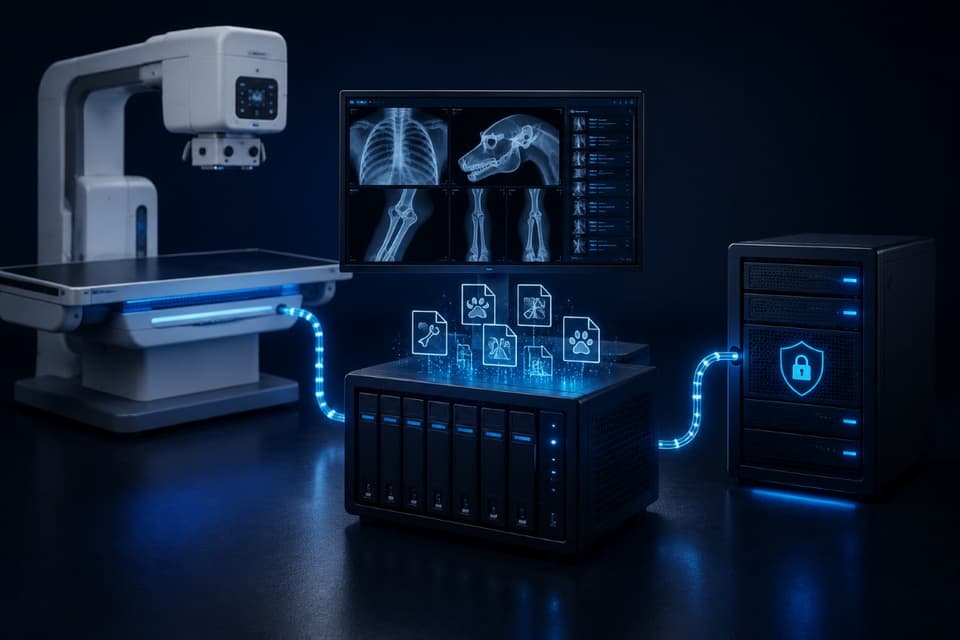
Modern veterinary diagnostics, digital radiography, ultrasound, increasingly advanced imaging at specialty and referral practices, generate large image files that need to be stored reliably, backed up properly, and remain accessible for treatment continuity and, not infrequently, legal or insurance purposes years later.
Practices running this equipment on whatever storage came with the imaging system, without a real backup strategy layered on top, are one hardware failure away from losing years of diagnostic history that cannot be recreated. This is squarely the kind of infrastructure planning that belongs in a genuine data backup and disaster recovery program rather than an assumption that the imaging vendor's default setup is handling it.
Payment Processing Deserves the Same Scrutiny as Any Retail Business
Veterinary practices process client payments daily, often for meaningful amounts given the cost of modern veterinary care, and that payment activity brings the same card and financial data security obligations that apply to any business accepting these transactions. Practices offering financing or payment plans for larger treatments handle an additional layer of financial data that deserves the same care.
This is not a veterinary-specific requirement so much as a retail and financial-transaction requirement that veterinary practices sometimes overlook because payment feels incidental to the actual medical work, when in security terms it deserves the same attention a retail checkout system would receive anywhere else.
After-Hours Access Is Not Optional in This Industry
Veterinary emergencies do not wait for business hours, and a practice offering any after-hours or emergency service needs its critical systems, patient history, medication records, contact information, reliably reachable at two in the morning, not just during the workday.
This reality shapes technology decisions differently than in a typical small business: remote access needs to be genuinely dependable rather than an occasional convenience, and support arrangements need to account for the real possibility that a critical system problem happens outside standard business hours, precisely when the practice can least afford a delayed response. A support relationship built around around-the-clock IT support fits this rhythm far better than a helpdesk that closes at five.
Multi-Location Practices Face a Standardization Challenge
Veterinary practices increasingly operate as small multi-location groups or as part of a larger practice network, and this growth introduces a technology challenge that a single-location clinic never faces: keeping patient records, scheduling, and security consistent across locations that may have grown through acquisition, each arriving with its own systems and habits.
A group that never standardizes finds itself supporting several different technology setups simultaneously, multiplying both cost and risk, since a security gap at one location is a security gap for the whole group's reputation. Bringing every location onto the same systems, the same security baseline, and the same support arrangement is unglamorous integration work, but it is exactly what turns a collection of clinics into a practice that scales sensibly.
A Practical Technology Checklist for Veterinary Practices
For a practice taking stock of where it stands today:
- Confirm practice management backups are real and tested, not just assumed to be running.
- Review diagnostic imaging storage and backup separately from whatever the imaging vendor set up by default.
- Treat payment processing as a security priority, not an incidental feature of the practice management system.
- Verify remote access actually works reliably for any after-hours or emergency coverage the practice offers.
- Standardize systems across every location if the practice operates or plans to operate more than one site.
Client Reminders and Communication Systems Carry Real Weight
Appointment and vaccination reminder systems have become central to how veterinary practices maintain client relationships and compliance with recommended care schedules, and these systems typically hold the same client contact information and pet health summaries as the core practice management system, sometimes in a separate platform that receives less security attention than the primary one.
A reminder system integrated cleanly with practice management reduces double data entry and keeps information consistent; a bolted-on, loosely connected one becomes another place client data lives that nobody is specifically responsible for securing. Treating these communication tools as part of the practice's real technology footprint, not a marketing add-on outside the scope of IT support, closes a gap that grows quietly as more client-facing tools get added over time.
Choosing IT Support That Understands Veterinary Medicine
A veterinary practice evaluating IT support should look for a provider who understands practice management software, diagnostic imaging storage needs, and the after-hours reliability this industry requires as familiar territory rather than something learned for the first time on the practice's account.
That familiarity matters most exactly when it counts, during an emergency visit at an inconvenient hour, or when a hardware failure threatens years of diagnostic history, and it is worth confirming during the selection conversation rather than discovering during an actual crisis. This is the kind of specific operational understanding that separates genuine managed IT services built for a practice's real rhythm from a generic package applied to it.
The Front Desk Is Where Most Data Actually Moves
The front desk of a veterinary practice handles a striking volume of sensitive activity in a normal day, checking in patients, processing payments, sending records to referral practices, and answering phone calls that often involve confirming a client's identity before discussing their account.
This makes front desk staff the practical center of the practice's data security, not an afterthought behind the clinical team, and training that focuses only on veterinarians and technicians while leaving front desk staff to figure out phishing and payment security on their own misses where a large share of daily risk actually sits.
Vendor and Equipment Contracts Deserve a Technology Review
Veterinary equipment, imaging systems, laboratory analyzers, practice management software, is often sold with service and support contracts that a practice signs without a technology-literate eye reviewing what happens if the vendor's own systems fail or the practice needs to switch platforms later.
IT support for veterinary practices should include a look at these contracts specifically: does the practice actually own its data or merely have access to it through the vendor's platform, what happens to years of patient history if the practice switches practice management systems, and who is responsible when a piece of connected diagnostic equipment stops communicating with the rest of the practice's network.
These are not questions a veterinarian trained in medicine should be expected to answer alone, and a technology partner who reviews new equipment and software contracts before signature, not after a problem surfaces, prevents a category of headache that is otherwise discovered at the worst possible moment.
Staff Turnover Is a Bigger Access Risk Than It Looks
Veterinary practices, like much of healthcare-adjacent work, experience real staff turnover among technicians and front desk personnel, and every departure is a moment where system access should be cleanly and promptly removed rather than left dangling.
A practice management system with a login still active months after someone left is not a hypothetical risk, it is a common finding whenever anyone actually audits access at a practice that has never made offboarding a formal, checklist-driven step.
Building a simple, consistent departure procedure, access removed the same day, shared passwords never used in the first place, closes a gap that costs nothing to fix and quietly persists in practices that have never been asked to think about it.
The Technology Behind the Care
Veterinary medicine runs on trust, from clients who hand over both their animals and their financial information, and the technology underneath that trust deserves the same seriousness as the medicine itself. IT support for veterinary practices done well means a practice management system that stays up when the whole day depends on it, diagnostic images that survive a hardware failure, payment processing treated with real security scrutiny, and remote access that actually works at two in the morning when an emergency walks through the door, which together is what genuinely reliable IT support for veterinary practices looks like in daily practice.
For practices in the region, a partner providing IT services in Thousand Oaks can review your diagnostic imaging backups and confirm your after-hours access actually holds up under pressure.
Practices across the Valley can get the same locally through IT support in the San Fernando Valley, from payment security to standardizing every location you operate.
If your practice has never had its diagnostic imaging backups or after-hours access actually tested, GlobeVM can review both and deliver the kind of IT support for veterinary practices your patients and clients deserve.