
Nobody has ever admired a business for its cabling. It sits behind walls and inside ceilings, doing its job invisibly for years. Then a single loose connection takes down a whole office, and the technician trying to fix it finds a tangle of unlabeled wires nobody can explain.
Structured cabling is the unglamorous discipline of doing that wiring properly the first time, and it is one of the few IT investments that costs almost nothing to get right during construction and a fortune to fix afterward.
This guide explains what structured cabling means, why it matters far more than its invisibility suggests, how to think about cable categories without needing an engineering degree, and when a business should invest in it.
What Structured Cabling Means
Structured cabling is a standardized, organized approach to a building's network wiring. Every cable run follows a consistent design, terminates in a labeled, documented location, and connects back to a central point in a predictable way, rather than accumulating as a patchwork of whatever connection solved yesterday's problem.
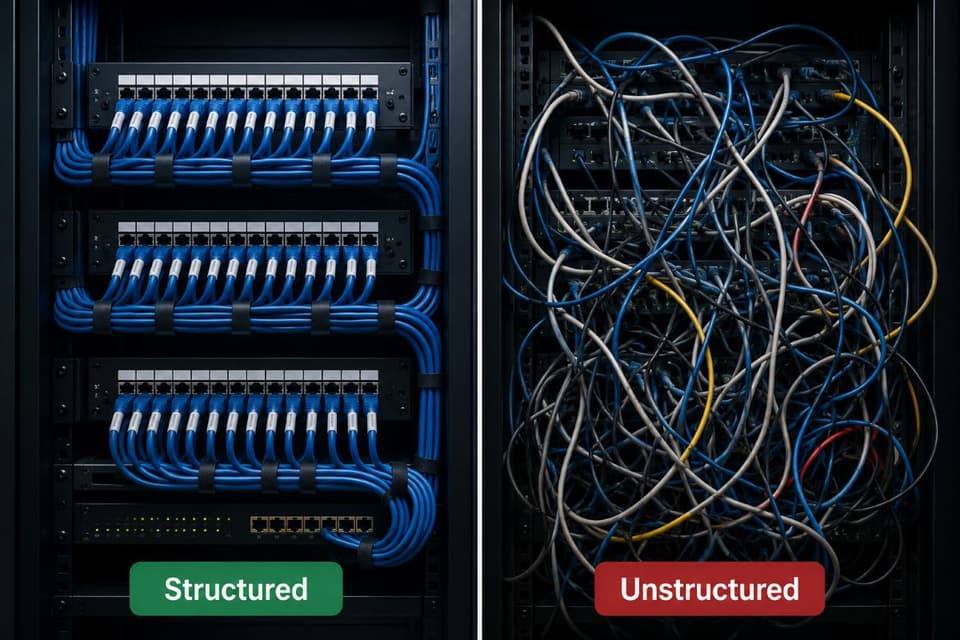
The opposite, unstructured cabling, is the tangle most people picture when they imagine a messy server closet. Cables are added one at a time over years, run wherever was convenient, and labeled inconsistently or not at all, with nobody holding a complete picture of what connects to what. Both approaches can technically work on the day they are installed.
The difference shows up entirely in what happens next, when something needs to be diagnosed, moved, or expanded, which is precisely the moment unstructured cabling turns a ten-minute fix into a half-day investigation.
Structured Versus Unstructured, Side by Side
The difference is easiest to see line by line, because both approaches look the same on the day they are installed.
| Structured cabling | Unstructured cabling | |
|---|---|---|
| How cables are run | To a design, every run following the same pattern back to a central point | Wherever was convenient at the time, added one at a time |
| Labeling and documentation | Every run labeled at both ends, with a diagram and test results on file | Inconsistent or missing; knowledge lives in someone's head |
| Troubleshooting a failed connection | Trace a labeled run, test it, done in minutes | Find the right cable first, often by following it through a ceiling |
| Adding a desk or moving a team | A known, bounded task | An investigation into what capacity really exists |
| Verified at installation | Yes, every run tested against its rated standard | Usually a visual check that it is plugged in |
| Upfront cost | Somewhat higher | Lower |
| Cost over the life of the building | Lower, because every future change is faster | Higher, paid in diagnostic hours and retrofits |
Why This Boring Infrastructure Matters
The case for structured cabling rests on three practical consequences that compound over the life of a building.
Troubleshooting Time, Multiplied
When a connection fails in a structured system, a technician traces a labeled cable from a documented endpoint to a documented termination point and tests it. Within minutes they know whether the problem is the cable, the equipment, or something else.
In an unstructured environment, that same diagnosis starts with identifying which of dozens of unlabeled cables is even the right one, often by physically following wire through a ceiling or wall cavity, before the actual troubleshooting can begin. Multiply that difference across every network issue a growing business will have over the coming years, and the hours saved by proper documentation dwarf the modest cost difference at installation.
Moves, Adds, and Changes Stop Being Small Emergencies
Every business eventually adds a desk, moves a department, or expands into more space. Structured cabling turns each of these into a known, bounded task: confirm the drop exists or plan a new one following the established pattern, then connect the equipment. Unstructured cabling turns the same request into an open-ended investigation of what capacity exists and whether adding one more connection will overload something nobody fully mapped.
Businesses that grow or reconfigure their space more than once, which describes most small businesses eventually, feel this difference repeatedly rather than once.
Reliability Compounds Quietly
Poorly installed or ad hoc cabling develops problems that unstructured environments are bad at catching early. A cable runs too close to electrical interference, a connection is stressed by a bend it was never designed for, or a termination done in a hurry works today and fails intermittently in six months.
Structured cabling, installed to a real standard and tested at completion, catches these problems before they become the mysterious, occasional outage that costs far more in diagnostic time than the original installation would have cost to do properly.
Cable Categories, Without the Jargon Overload
Cabling specifications get discussed in a shorthand that sounds more intimidating than it needs to be, so here is the plain-language version. Cable categories, labeled Cat5e, Cat6, Cat6a, and newer designations, describe how much data a cable can reliably carry and how resistant it is to interference, with each step up the sequence supporting faster speeds over longer distances.
The practical guidance for most small businesses installing new cabling today: choose at least Cat6, since the cost difference over older standards is minor relative to the installation labor, and it comfortably supports the speeds most modern equipment expects.
Businesses anticipating heavier future demands, such as larger file transfers, more connected devices, or longer runs between floors, should ask their installer whether Cat6a is worth the modest additional cost. Re-running cable to upgrade later costs far more than installing the higher standard the first time.
What matters more than memorizing the specification numbers is the underlying principle: cabling installed today should be sized for tomorrow's demands, not merely today's. The labor cost of installation dwarfs the material cost of a better cable, and that labor only happens once if it is planned correctly.
Cat6 vs Cat6a: Which One for a New Office?
The two are easy to confuse because both can carry 10 Gbps. The difference is distance. Cat6 carries 10 Gbps only up to about 55 meters, and less in crowded cable bundles, while Cat6a holds 10 Gbps across the full 100-meter channel. Cat6a is also the safer choice where many runs feed high-power PoE devices such as cameras, access points, and door controllers, because it handles the extra heat in a bundle better. For a small office with short runs and ordinary equipment, Cat6 is a sensible default. For new construction or anything you expect to keep for fifteen years, the small extra cost of Cat6a is usually worth it, since the labor to re-run cable later is the expensive part.
| Category | Top speed | Distance at that speed | Bandwidth | Where it fits |
|---|---|---|---|---|
| Cat5e | 1 Gbps | 100 m | 100 MHz | Existing installs; not the right choice for new work |
| Cat6 | 1 Gbps at 100 m; 10 Gbps up to about 55 m | 100 m (at 1 Gbps) | 250 MHz | Most small offices with shorter runs |
| Cat6a | 10 Gbps | 100 m | 500 MHz | New builds, long runs, dense high-power PoE, a 15-year horizon |
| Cat8 | 25 to 40 Gbps | 30 m | 2,000 MHz | Server rooms and data centers, not desk runs |
The Hidden Cost of Skipping It
The most expensive version of structured cabling is the one installed after everyone has already moved in. Running new cable through finished walls and populated ceilings means cutting into drywall, working around furniture and active workstations, and coordinating around a business that is trying to operate normally. All of that multiplies both the labor cost and the disruption compared to installing the same cable while a space sits empty.
This timing point deserves to be said plainly: the cheapest moment to install structured cabling correctly is before anyone occupies the space. New construction and office relocations both provide that planning window, and it rarely gets used.
Businesses that treat cabling as an afterthought, something to sort out once the desks are already in place, routinely pay several times the original installation cost to retrofit what could have been planned in from the start.
What Structured Cabling Costs
Published installer pricing for 2026 puts a fully installed, terminated, and tested Cat6 drop at roughly $150 to $300 in most US commercial markets, with Cat6a typically running $200 to $400 per drop. Southern California installers quote in the same band, and they note that retrofit work in occupied space usually costs 30 to 60 percent more per drop than the same run in new construction. The cable itself is a small part of that number. Labor, access, and whether the quote includes testing and documentation drive the rest, which is why two quotes for the same drop count can differ so much.
Testing and Certification: Confirming the Work Is Right
A structured cabling installation is only as good as its verification, and this is the step corners get cut on most often. Every cable run should be tested at completion against the standard it was sold as meeting, confirming actual performance rather than trusting that a cable rated for a certain speed was installed correctly enough to deliver it.
Poor termination, a cable run too close to interference sources, or a run pushed beyond its supported distance can all produce a connection that technically works but underperforms or fails intermittently. That kind of problem is far cheaper to catch during installation testing than to diagnose months later as a mysterious recurring issue.
A reputable installer provides documentation of these test results as a matter of course; a business that receives cabling work without that documentation has no real way to confirm what was delivered matched what was promised.
A Note on Choosing an Installer
Not every electrician who runs a cable is a structured cabling professional, and the distinction matters more than the price quote usually suggests. Ask specifically about certification to the standard you are paying for, the testing equipment used to verify each run, and whether documentation is included or billed separately. A low quote that omits documentation and testing is not the cheaper option once the first troubleshooting call arrives.
A provider that also handles your broader managed IT services has a direct incentive to get the physical layer right, since they are the ones who will live with the consequences of a shortcut.
The Documentation You Should Receive
A finished structured cabling job should leave you with more than working connections. It should leave you with a real record: a labeled diagram showing where every drop terminates, a naming convention applied consistently across the installation, and the test results for every run.
This documentation is what makes future troubleshooting, moves, and additions fast rather than exploratory, and its absence is the clearest sign an installation was done as a favor rather than as a proper project. Ask for it explicitly before work begins, because a provider who has never been asked will sometimes need to be told this is a requirement, not a nice-to-have. The help desk and IT support team that inherits your network later will thank you for it.
What a Professional Installation Involves
For businesses who have never bought this kind of work before, it helps to know what a proper installation looks like beyond the cable itself. A real structured cabling project starts with a design pass, mapping where every drop needs to go based on the actual floor plan rather than guessing during installation.
It includes a labeling standard applied consistently to every run and every termination point, so the documentation is usable by someone who was not present for the install. It includes patch panels and organized termination in the network closet itself, not cables running directly and chaotically into equipment, since the closet is where troubleshooting begins.
And it ends with the testing and certification covered above, not a visual check that the cable is plugged in. A quote missing any of these elements is a quote for wiring, not for structured cabling, and the difference between the two only becomes obvious the first time something needs to be diagnosed.
Wireless Does Not Remove the Need for Cabling
A common assumption deserves a direct answer: no, a strong wireless network does not remove the need for structured cabling, it depends on it entirely. Every wireless access point in a modern office connects back to the network through a cable, and the quality, placement, and organization of that cabling directly determines how good the wireless coverage is. The access points then need wireless network security of their own.
A business that invests in premium Wi-Fi equipment while running it over ad hoc, undocumented cabling is building a fast car with a weak frame. The visible layer improves while the invisible layer it depends on stays as unreliable as before.
Structured cabling and good wireless design are not competing investments; they are sequential ones. Skipping the first to fund the second usually shows up later as wireless dead zones nobody can explain, since the real cause is buried behind a wall. Keeping both layers healthy after installation is the everyday work of network management.
When a Business Should Invest in Structured Cabling
Three moments make the investment in proper structured cabling close to non-negotiable. New construction or a build-out, where the walls are already open and the incremental cost of doing cabling correctly is at its absolute lowest. An office relocation, for the same reason, since the space sits empty during the window when cabling work is cheapest and least disruptive. Cabling is one line in a longer IT relocation plan, and it is the one with the least room for delay.
And a business running on cabling nobody fully understands, inherited from a previous tenant, added piecemeal over years, or installed without documentation. There, the ongoing cost of that uncertainty in troubleshooting time and unreliability eventually exceeds the cost of doing it properly once.
Outside those moments, a business with working, documented cabling has little reason to disturb it; this is an investment made at the right structural moment, not maintained on a routine schedule the way software or hardware typically are.
Companies in the Conejo Valley planning a move or build-out can get the walkthrough done locally through IT support in Westlake Village, from the first site visit to a tested, certified installation.
Invisible Infrastructure, Visible Consequences
The businesses that never think about their cabling are, almost without exception, the ones whose cabling was done properly the first time: labeled, documented, tested, and sized for more than the day it was installed. Structured cabling earns exactly zero admiration when it works, which is precisely the point, and it earns an expensive, disruptive retrofit when it was skipped.
If your business is building out new space, relocating, or has inherited a tangle nobody can explain, fix it now. The right moment is before it becomes the reason an outage takes four hours to diagnose instead of ten minutes.
For businesses in the region, a partner providing IT services in Ventura County can document what exists today and plan any new cabling on paper before a single wall is cut.
If nobody at your business can explain what your office structured cabling looks like behind the walls, talk to GlobeVM. We can document what exists today and plan it properly for whatever comes next.